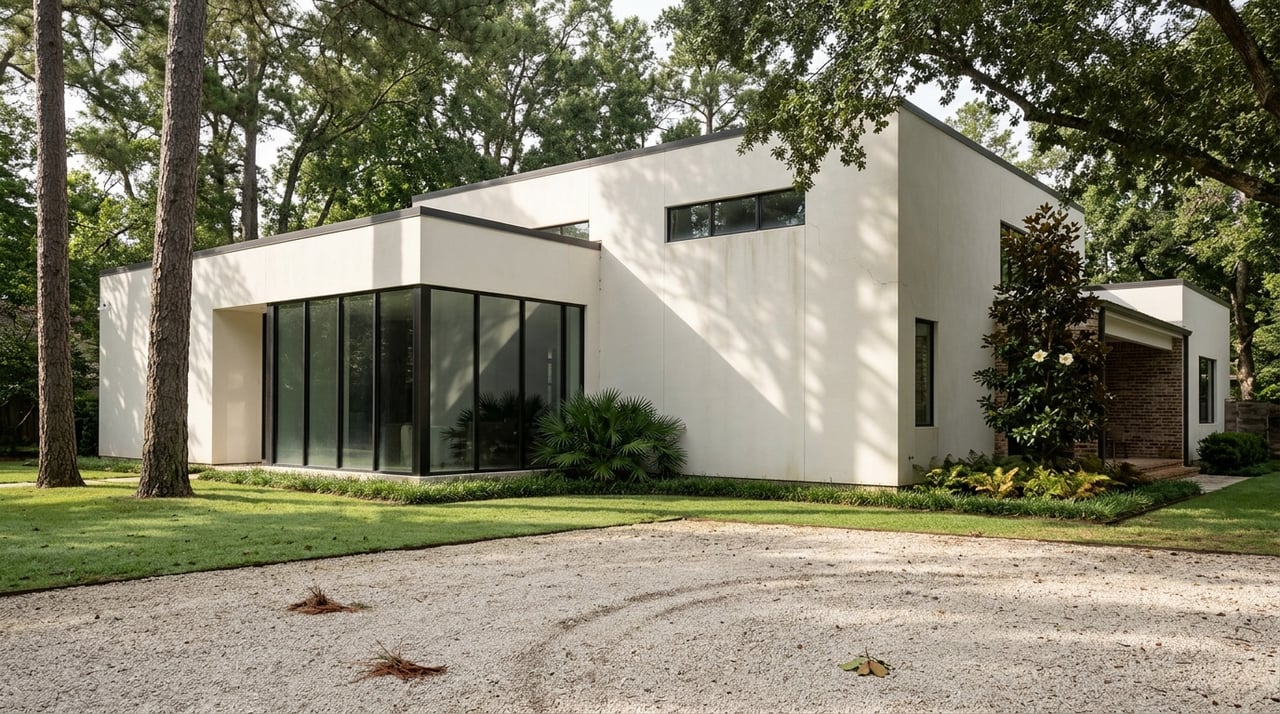
What if a lot's tree line isn't the seller's landscaping choice, but a decision the city already locked in years ago?
Memorial is not one city, and most buyers already know that much. What fewer people realize until they're deep into a renovation or new build is that the six incorporated Memorial Villages, Bunker Hill, Hedwig, Hilshire, Hunters Creek, Piney Point, and Spring Valley, each run their own tree ordinance, and at least one of them writes a rule that follows the land rather than the person who owns it. If you buy a lot where someone already pulled a tree removal permit and then didn't build what they said they would, the limits on what you can clear may already be set. That's true even if you never met the previous owner and have no idea a permit was ever filed.
This matters most for anyone weighing a teardown or a major addition on a wooded Memorial lot, which describes a meaningful share of buyers here given how much of the housing stock still sits on its original 1950s and 1960s footprint under decades-old canopy.
Six cities, six rulebooks
Each Village sets its own permit trigger for tree removal, and the thresholds are not close to each other.
| Village | Permit trigger | What makes it distinct |
|---|---|---|
| Piney Point Village | Any live tree 3 inches or larger in diameter, measured at 4 feet 5 inches above grade | Driveways and other flatwork count toward the lot's coverage limit, so patios and motor courts run through the same review as tree removal |
| Hilshire Village | 8 inches or larger | Removal of a protected tree requires a replacement planting under the ordinance |
| Spring Valley Village | 6 inches or larger | $50 application fee, a 10 business day review period, and added scrutiny for any tree within 50 feet of a public right of way |
| Bunker Hill Village | Protected species defined by ordinance | Runs an offsite tree replacement program, so a removed tree can be replaced elsewhere in the city instead of on the same lot, and requires dead tree stumps cut to no more than 6 inches above soil |
| Hunters Creek Village | Any protected tree, confirmed by a professional tree survey | Permits are tied to a specific improvement, with a five year bar on a second permit for a similar project if the first one goes unbuilt |
| Hedwig Village | Independent ordinance requiring a permit for protected species | Shares its water utility, the Memorial Villages Water Authority, with Hunters Creek and Piney Point, though its tree code runs on its own separate track |
A 3 inch trunk in Piney Point needs the same paperwork as a mature oak. In Hilshire, that same 3 inch tree could come down without a permit, while an 8 inch tree triggers a replacement requirement. Two nearly identical lots a few streets apart, one in each Village, can face entirely different math on the same rebuild.
The clause that follows the lot
Hunters Creek Village's ordinance, codified through Ordinance No. 2025-965 in October 2025, goes further than a size threshold. A property owner who wants to remove protected trees to build or renovate has to submit a current tree survey along with a tree disposition and protection plan before the city will even consider a permit. The city grants it only if the applicant shows the removal is necessary for reasonable use of the site and that alternatives, including redesigning the project, were considered.
Here's the part that changes how a buyer should shop a wooded lot in Hunters Creek. Once a permit is granted for a particular improvement and the trees actually come down, no new permit can be issued for removing additional protected trees for a similar improvement for five years from the date the first permit was issued. The ordinance spells out the scenario directly: if a permit is granted to clear trees for a new residence and the property owner, "or his successor in title," decides not to build that residence, any future proposed residence has to be designed to fit within the area already cleared. It cannot require taking down more trees. Filing the application in the first place is treated as an admission that a reasonable improvement can be built without further removal.
That phrase, successor in title, is doing real work. The five year restriction doesn't reset with a sale. If you buy a lot where a prior owner pulled a permit, cleared trees for a house they never finished, and moved on, you inherit whatever footprint that clearing already defined. Your architect isn't starting from a blank canvas. They're designing around a boundary someone else set, possibly years before you made an offer.
Same question, different answers next door
Piney Point Village takes a different approach that still shapes design decisions early. Its threshold catches nearly every tree on a lot, and because driveways, patios, and other flatwork count toward overall lot coverage, a pool deck or an expanded motor court can run into the same review process as removing a tree. The city's new construction checklist for the Village bundles the tree disposition plan in with several other approvals, including sign off from the Memorial Villages Water Authority, a height certificate, drainage acknowledgement, and sprinkler review, so tree permitting is one piece of a longer sequence rather than a standalone step.
Bunker Hill Village solves a similar problem with a different tool. Its offsite tree replacement program lets a homeowner satisfy a replacement requirement by planting elsewhere in the city instead of squeezing a new tree back onto the same lot, which matters on a site where the whole point of the rebuild was to open up more usable yard. Bunker Hill also carries a separate rule allowing an interior remodel of more than 50 percent of a structure, even one with an existing exterior nonconformity, as long as no exterior changes are planned. For a buyer weighing a full gut renovation against a teardown, that provision can tip the math toward keeping the shell and rebuilding inside it.
None of this shows up on a listing sheet. It shows up when an architect calls the city to ask what's actually buildable.
Before you put in an offer
A few questions are worth asking before you write a number on a wooded Memorial lot, especially one with any sign of prior clearing:
- Ask whether a tree survey or disposition plan is already on file with the city, not just a boundary survey from the title company
- Ask directly whether a tree removal permit was ever pulled on the lot, and what improvement it was tied to
- If the lot sits in Hunters Creek, get the date of any prior permit, since the five year clock runs from issuance, not from your closing date
- Bring your architect or builder into the conversation before you finalize price, since the real buildable footprint might already be narrower than the lot line suggests
- If you're comparing a renovation to a teardown, ask about Piney Point's lot coverage counting or Bunker Hill's 50 percent remodel provision, since either one can change which option actually pencils out
A few questions we get
Does this apply if I'm renovating instead of tearing down? In some Villages, yes. Piney Point counts flatwork like patios and driveways toward lot coverage, so a renovation that adds hardscape can trigger the same review as tree removal even without a full rebuild.
What if my lot is in a Houston-proper section of Memorial, not one of the six Villages? Houston runs its own tree and shrub ordinance, which focuses on trees in the public right of way and sets separate protection for corridor trees, generally described as trees 20 inches or more in diameter within the building setback along a local street or major thoroughfare. It does not carry anything resembling Hunters Creek's five year rebuild restriction, which is specific to that Village's code.
Can a new owner ask to have the five year restriction waived? The ordinance text doesn't describe a buyer exception. It refers explicitly to a successor in title, which is the mechanism that makes the restriction travel with the parcel rather than resetting at closing.
A wooded lot in Memorial is rarely just a wooded lot. It's a set of decisions some prior owner, builder, or city already made, sitting quietly in a permit file until your architect goes looking for it. If you're evaluating a teardown or a major rebuild anywhere in the Villages, that file is worth reading before the offer, not after.
Nancy Almodovar and her team work Memorial's estate and new construction market across all six Villages and the surrounding Houston sections, and can help you get the right questions in front of the right city office before you commit to a lot.