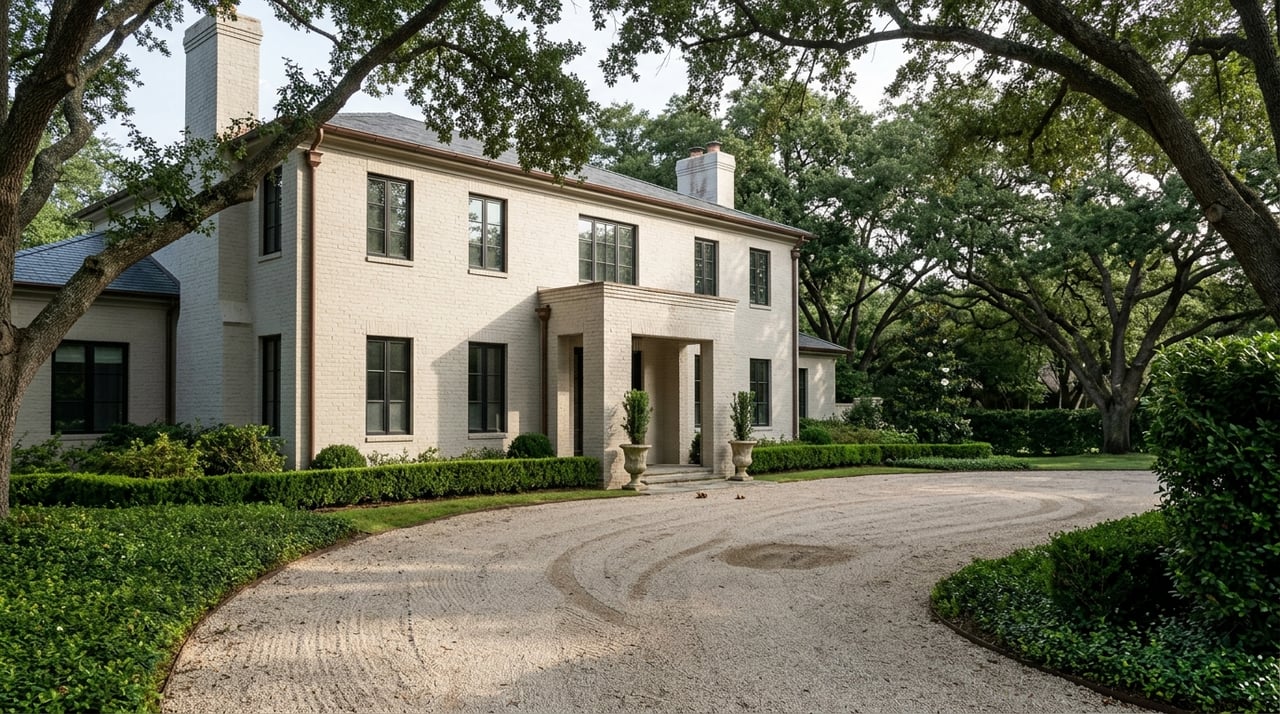
Houston attorney Tony Buzbee closed on a house last month for $15.5 million. He does not plan to live in it, furnish it, or list it again. He plans to knock it down.
The property sits at 1708 River Oaks Blvd, one lot over from the mansion Buzbee has owned since 2013. According to the Houston Chronicle, the 15,000-square-foot estate, built in 2005 with muraled ceilings and an enclosed pool beneath a star-lit dome, topped the Houston Association of Realtors' list of the city's most expensive home sales for July 2026. Buzbee told the paper he never cared for the house. "I absolutely hate the style and inside decor," he said, adding that once demolition is done he'll "have it blessed and then build a pool house and garden."
Treated as gossip, this is a one-day story about a trial lawyer with money to spend on privacy and a garden. Treated as a market signal, it's one of the clearest illustrations available right now of how pricing actually works in River Oaks, and why the headline "median price" a buyer sees on a national portal tells them almost nothing about what a specific address is worth.
The Sale That Isn't About the House
Buzbee didn't overpay for a bad renovation. He paid for the lot, the address, and the ability to control what happens next door to his own home. That's not an unusual calculation inside River Oaks' deed-restricted core. Acre-plus lots inside those restrictions routinely carry $4 million to $7 million in land value alone before a single wall goes up, and tear-down purchases of $3 million or more are common precisely because builders and buyers price the deal against the underlying dirt, not the square footage sitting on it.
This has been the pattern for years, not a 2026 novelty. Houston approved close to 80 demolition permits across River Oaks and its adjacent sections over a single two-year stretch in 2018 and 2019, taking down city-designated landmarks along with ordinary mid-century houses. The mechanism hasn't changed since. Community Impact's weekly "Demo Monday" column, which tracks demolition permits across Houston, flagged a River Oaks teardown in its early-August 2026 roundup: a 1939-built mansion on Pelham Drive valued at roughly $2.8 million by the Harris County Appraisal District, torn down not because it was unsound but because the land under it was worth more as a blank slate.
Once you see the pattern, the Buzbee purchase stops looking eccentric. It looks like the median month in River Oaks.
Two Datasets, Two Stories
Here's where it gets useful for anyone actually comparing neighborhoods right now. Pull up two of the most commonly cited third-party sources for River Oaks and you get two contradictory stories about the same market.
| Metric | Redfin (March 2026) | Orchard (30 days ending late April 2026) |
|---|---|---|
| Median sale price | $2.1M, down 6.6% year over year | $3.085M, up 28.5% year over year |
| Median price per square foot | $632, up 22.2% year over year | $651.70, up 3.4% year over year |
| Homes sold in the window | 29 | 5 |
| Median days on market | 51 (vs. 97 the prior year) | 14 (vs. 10 the prior year) |
Read those two rows side by side and the neighborhood appears to be simultaneously cooling and overheating. It's neither. It's a market small enough that a handful of transactions can swing the average by tens of percentage points depending on which thirty-day slice you happen to be looking at.
Why Five Sales Can Move a Median More Than Fifty
River Oaks holds fewer than 1,300 single-family homes inside its core deed restrictions, and in a typical month fewer than 25 are actively listed across the Country Club Estates, River Oaks Section One, and the boulevard combined. When Orchard's window captured only 5 closings, one land-value sale in the $3 million to $8 million range, exactly the kind of transaction Buzbee just completed, is enough to pull the median sharply in either direction. Redfin's larger 29-sale window absorbed more of that noise and came out with a falling median even as price per square foot climbed, which is its own tell: the mix of what sold that month, not underlying softness, is doing the work.
This is the part a portal search doesn't show you. A shrinking median next to a rising price per square foot usually means fewer of the priciest trophy estates changed hands that month, not that River Oaks got cheaper. A median that jumps 28% in the next window usually means the opposite: a couple of high-dollar land sales landed in the sample. Neither number describes what a buyer should expect to pay for a specific house on a specific street. Both are accurate. Neither is useful on its own.
The Rulebook Under the Canopy
Part of why land carries so much of the value here traces back to restrictions that outlive every owner who's ever held title. River Oaks Property Owners, Inc., known locally as ROPO, still administers deed restrictions written in the 1920s covering setbacks, height, materials, and tree preservation. Those rules are a meaningful reason the mature oak canopy along the boulevard has survived a century of teardowns instead of being cleared for driveways and pool decks.
The rules haven't always been uniform. For decades River Oaks operated under 23 separate sets of block-by-block deed restrictions, a patchwork dating to the neighborhood's founding by Will and Michael Hogg in the 1920s. ROPO consolidated those into one restated set only after years of town halls and committee drafts, a process that itself took close to a year to finalize. Today, any owner planning new construction or a substantial renovation has to submit a major project application through ROPO's deed restrictions department before permits move forward, and tree removal tied to construction requires its own sign-off on the design plan.
That review layer is part of why builders and buyers underwrite an 18 to 24 month construction timeline once permits are issued. It's also why cash offers and waived inspection contingencies are common at the top of the market: when a buyer is purchasing at land value with a teardown already planned, the condition of the existing structure is close to irrelevant, and the clock that matters is ROPO's, not the inspector's.
Reading a River Oaks Listing Without the Median
If the neighborhood median can't tell a buyer what a house is worth, here's what actually does the work.
- Where inside River Oaks it sits. Estates along Lazy Lane, Inwood, and Del Monte trade between $8 million and $25 million. The boulevard itself, between Westheimer and Buffalo Bayou, holds many of the largest original John Staub houses and sits at the top of the price ladder. Side streets in River Oaks Section Two, west of Willowick, run $2 million to $6 million for renovated historic homes. Three addresses inside the same zip code can be priced for entirely different reasons.
- Whether the structure is being priced as a house or as land. A listing agent pricing near replacement value on a dated structure is signaling a teardown candidate, whether or not the word appears in the description. Compare the asking price against recent land-value sales on the same block, not the neighborhood median.
- The ROPO timeline, if the plan involves construction. Budget the deed restriction review into your schedule alongside the 18 to 24 month build. A house that looks like a bargain because it needs work is only a bargain if the rebuild clears major project review on the timeline you need.
- How much of the real activity happens off-market. Public MLS listings represent only part of what trades in River Oaks Country Club Estates and Section One. An agent working the neighborhood full time, with relationships to sellers who never formally list, sees inventory that never shows up in a portal search at all.
A Few Questions We Get
Does the "median price" on a portal include off-market sales? No. Portal medians are built entirely from what closes through MLS. In a neighborhood where a meaningful share of top-tier trades happen privately, the published median is working from an incomplete sample even before you factor in month-to-month volatility.
How can I tell if a listing is priced for the house or for the land underneath it? Compare the asking price per square foot against recent land-only or teardown sales on the same block, not the neighborhood average. If the number tracks closer to land value than to renovated comps nearby, the house itself is likely a placeholder.
Why do some River Oaks listings mention ROPO or a "major project application"? Any new construction or substantial renovation inside the deed-restricted sections needs review by River Oaks Property Owners before permits move forward. A listing that flags this is telling you the review clock, not just the construction clock, is part of the timeline.
River Oaks doesn't reward buyers who anchor on a headline number. It rewards buyers who know which few blocks, which lot sizes, and which review timelines actually set the price, and who have someone in their corner who tracks that market street by street rather than month by month. That's the work Nancy Almodovar and her team do for clients across River Oaks every day. If you're evaluating a purchase or a sale here, talk to us before you trust a number a portal generated from five closings.