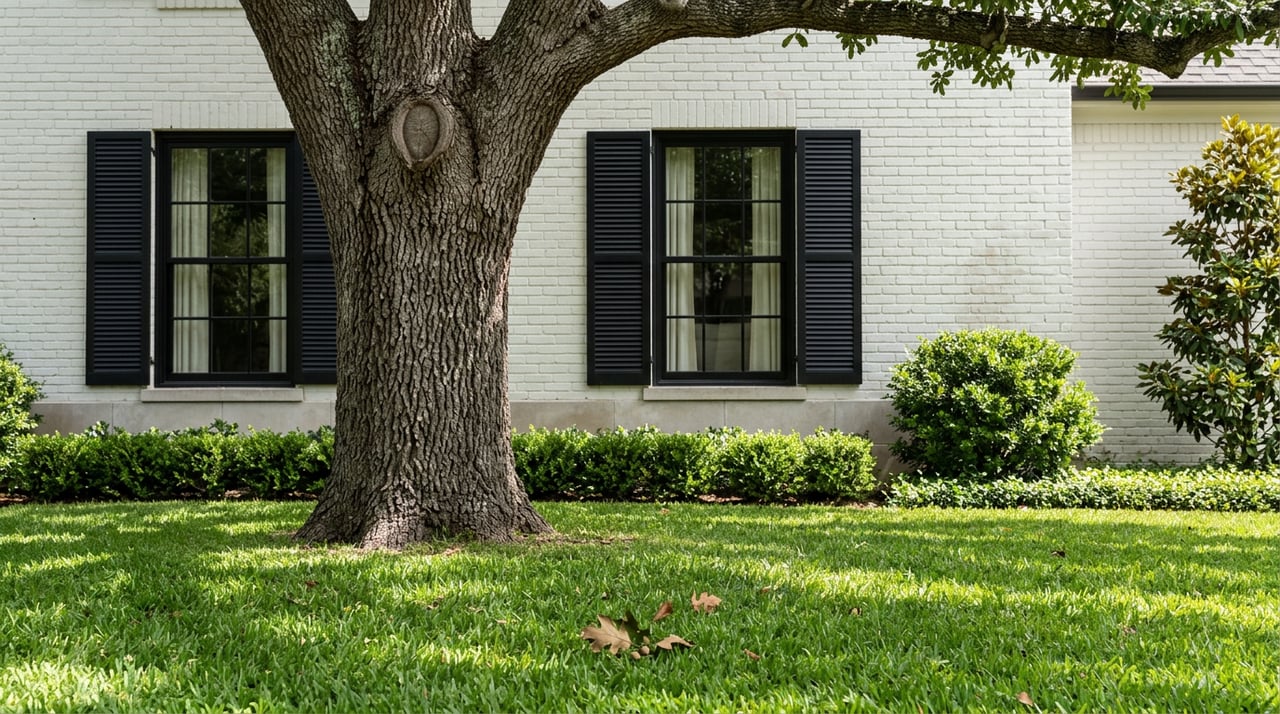
A redevelopment buyer walks a Memorial lot with two documents in hand. The first is the survey. The second is a tree disposition plan their architect has roughed out from the city's protected-tree definitions. The offer that lands on the listing agent's desk a week later is not priced from the survey. It is priced from the disposition plan.
That sequence is the part most sellers in Bunker Hill, Hunters Creek, and Piney Point Village do not see until repricing has already started. The live-oak canopy that helped justify the list price also writes a rulebook for what a buyer can build beneath it, and each city writes that rulebook a little differently.
The thesis, in one paragraph
Across the Memorial Villages, the building footprint a teardown buyer is willing to underwrite is constrained less by setbacks, FAR, or finishes than by the tree disposition plan filed with the village. That plan is governed by the address, not the brokerage. Two functionally identical lots a quarter mile apart can produce two materially different bids because one sits in Hunters Creek and the other in Piney Point. Sellers who pre-stage the survey, the disposition plan, and a conversation with the village's Urban Forester protect price. Sellers who wait for the buyer's architect to do that work first underwrite the discount.
Three villages, three rulebooks for the same canopy
The ordinances share a vocabulary. They diverge on the mechanics that matter at underwriting.
| Village | What triggers the plan | Offsite tree rule | Replacement standard | Documented enforcement lever |
|---|---|---|---|---|
| Hunters Creek | Tree survey + tree disposition and protection plan required for development activity; written Urban Forester sign-off required before a demolition permit releases | Protected if 30% or more of the critical root zone falls within the site | Replacement trees required under Sec. 18-20(e); root pruning, vapor barrier, and a root remediation schedule when impervious cover crosses a CRZ | Permit hold at demolition; MVWA water and sewer disconnect is a separate gate |
| Piney Point | Tree Disposition Plan filed against the Tree Criteria Manual; trees tagged and numbered to match the survey | Adjoining-easement trees with 30% or more of CRZ on site must be surveyed | Replacement minimum: 3-inch caliper measured 6 inches above grade, drawn from the Appendix A protected-tree list | $500 fine and authority to shut the job down for removing tree-protection fencing or signage |
| Bunker Hill | Tree permit required prior to any tree being cut down; new construction follows a site plan with a trees-per-square-foot requirement | Addressed through the 2020 Offsite Tree Replacement Program | Dead trees must be removed, with no portion of the remaining stump higher than 6 inches above soil | Citation for removal without permit; site-plan tree count enforced at certificate of occupancy |
A buyer reading those three columns is reading three different buildable envelopes. The 30-percent rule in Hunters Creek and Piney Point is the one most often missed. A neighbor's heritage oak, rooted twenty feet outside the property line, can extend a protected critical root zone deep into the side yard a developer planned to use for a motor court. The Hunters Creek code is explicit:
Tree disposition and protection plan means a written plan… that shows how the protected trees and critical root zones on the site, and the critical root zones of protected trees that are located off of the site but that have 30 percent or more of their critical root zones within the site, are to be protected.
The math is straightforward and ruthless. Critical root zone is calculated as one foot of radius for every inch of trunk diameter. A 24-inch live oak on a neighbor's lot pulls a 24-foot protected radius. If a meaningful share of that radius crosses onto the seller's parcel, the buyer's architect either redesigns around it or absorbs the cost of root pruning, vapor barriers, and a root remediation schedule that Hunters Creek requires when any impervious surface crosses a CRZ.
What this does to the bid
The HAR May 2026 Housing Market Update, published June 10, recorded the strongest luxury performance of any segment in Greater Houston: sales of homes priced at $1 million and above rose 10.1 percent year over year, average price climbed 2.3 percent to $447,301, and pending sales across the region reached 9,172, the highest May since 2022. That demand is real, and it is reaching Memorial. What it is not doing is removing buyer discipline at the high end. A redevelopment buyer in this band is underwriting two numbers: replacement cost of the structure and residual lot value after the tree plan is honored.
When the tree plan reduces the buildable footprint by 600 square feet, the bid moves. Replacement caliper inches add direct cost. Piney Point's 3-inch caliper minimum, measured 6 inches above grade, is not a token landscaping charge once a project has to mitigate the removal of several mature canopy trees. Bunker Hill's Offsite Tree Replacement Program, adopted in 2020, gives buyers a fee path when on-site replacement is impractical, and that fee gets penciled in against the offer.
Sellers who arrive at the negotiation without their own tree survey concede the framing entirely. The buyer's architect produces the numbers. The seller responds to them.
The transaction-specific friction sellers miss
Three points of friction surface late in Memorial Villages teardown deals:
- The demolition permit gate. Hunters Creek will not release a demolition permit until the Urban Forester has signed off in writing on either a disposition plan or a no-removal letter, and until the Memorial Villages Water Authority disconnect paperwork is completed. A buyer relying on a fast demo to start framing in a target month learns that the village controls the calendar, not the closing date.
- The flagging protocol. Piney Point requires tagged-and-numbered trees on site keyed to the submitted survey, with orange tape for removal and green tape for protection, and field changes routed back through the Urban Forester before they happen. The current contact is Cary Moran. A buyer planning to swap a removal in the field after closing cannot, and prices that constraint in.
- The dead-tree clean-up rule. Bunker Hill requires dead trees removed with no stump section higher than 6 inches above soil. Sellers who leave that work for the buyer are handing over a punch list item the buyer will deduct for.
None of those frictions appear on a portal listing page. All of them appear in an underwriting model.
A pre-listing sequence that protects price
- Order a tree survey from a professional who works in your village. The survey should identify every protected tree on site by species and size, every off-site tree within range of the 30-percent CRZ trigger, and every dead or declining specimen that will draw a removal obligation.
- Walk the lot with the village's Urban Forester before the sign goes up. In Piney Point, that conversation is with Cary Moran. The point is to understand which trees are negotiable for removal under a replacement plan and which are not, before a buyer's architect tells you.
- Build a draft disposition plan. You are not filing it. You are giving qualified buyers a starting point that matches your view of the buildable envelope, not theirs.
- Quantify replacement cost at the village's standard. Use Piney Point's 3-inch caliper baseline as a conservative anchor across all three villages when underwriting. Bring the number to pricing conversations.
- Pre-clear the dead-tree and stump obligations. Particularly in Bunker Hill, where the 6-inch stump rule and the citation risk for unpermitted removal are documented in the city's own ordinance materials.
- Stage the demolition timeline assumption. A serious buyer will ask how long from contract to demo permit. If you already have a no-removal letter or an Urban Forester acknowledgment of your disposition plan, the answer shortens, and the contingency periods do too.
That sequence will not eliminate the discount embedded in canopy density. It moves the discount from the seller's column to the buyer's.
A short FAQ
If I am marketing the home as a turnkey residence, does any of this apply?
Yes, in a softer form. A renovation buyer planning a pool, a guest house, an expanded motor court, or a primary-suite addition will still trigger a tree disposition plan if protected trees are within the work zone. The constraint is smaller. It is not zero.
Can I remove a few protected trees quietly before listing to widen the footprint?
No. All three villages require a permit before any protected tree is cut down. Piney Point's manual provides for fines up to $500 for tampering with required protection signage and authority to shut the job down. Bunker Hill warns of costly citations for removal without a permit. The exposure runs with the land and surfaces in disclosure.
Are the village Urban Foresters open to pre-listing conversations?
Yes. The villages publish the role specifically because development activity in established areas is constant. Piney Point lists Cary Moran's direct contact in its permit packets. Hunters Creek routes the conversation through its building official and Urban Forester before a demolition permit can be approved.
Does the May 2026 luxury surge change the calculus?
It widens the bidder pool, which is what sellers want. It does not change how those bidders underwrite. The strongest of them are reading the ordinance text and the survey before they price the offer. The seller who has done that reading first holds the pen.
The Memorial Villages reward sellers who treat the canopy the way they treat the survey: as a document to be assembled before the conversation starts. The bid is set there.
To discuss a pre-listing strategy tailored to your village and your lot, Nancy Almodovar and the team at Nan & Company Properties are available for a private consultation. Work with Nancy Almodovar.